Classroom

Cover of AI for Teachers

AI for Teachers

Lesson, rubric, and a parent note before you leave.

Anyone can use this page. Copy the prompt and try it today.

$7.99

Buy · $7.99

A page inside

A page inside AI for Teachers: Forty minute lesson

Everyday AI

AI for Teachers

Lesson help without outsourcing judgment.

You stay the editor. The model drafts. You decide.

$7.99 · 20 pages

Beginner shelf · classroom prompts · you stay the teacher

Everyday AI · Teachers1 / 20

CONTENTS

What's in this book

Read pages 3 through 6. Then copy one cream box.

03The Idea — You were in the room
04What The Labs Found — Design matters more than the label
05Before You Paste — Clean the input first
06How To Use This — One box. One draft. One check.
07Forty Minutes Means Forty — Protect the student work
08Tonight’S Exit Ticket — Evidence, not a diagnosis
09Same Goal, Different On-Ramps — Support without shrinking the learning
10The Parent Email — Warm, factual, and yours
11A Rubric You Can Score — Observable beats impressive
12Sub Plans A Stranger Can Run — Remove what only you know
13The Week’S Words — Definitions students can use
14Questions That Make Room — Do not preload the theme
15General Iep Supports — Format options, not decisions
16Quiz And Key — Solve what the model writes
17Week Plan — Pick one pressure point
18Stuck — Repair the defect you can name
19You Make It Teachable — Keep the marks you made
20Sources — The research behind pages 3–4
Everyday AI · Teachers2 / 20

THE IDEA

You were in the room

At 6:42 on Sunday, Elena has a standard, a half-finished slide deck, and forty minutes for tomorrow’s lesson. A chat can give her a draft. It cannot tell her whether period three needs another example.

A model predicts language from patterns. It did not watch yesterday’s lesson. It does not know the copier is broken, which example landed, or what your school requires.

Use it for structure. Draft a timed lesson arc, exit ticket, plainer email, or first-pass rubric.

Use teacher judgment for decisions. You decide truth, fit, rigor, tone, access, policy, and readiness.

A prompt is a job. Name the Role, Task, Details, and Format. Paste exact source language when wording matters.

The failure mode: polished language can hide a false assumption. A neat plan may use content you never taught or materials you do not have.

HARD NOS

No identifiable student information. No invented standards, policies, diagnoses, accommodations, scores, or facts.

Then do this: Circle every claim that depends on your classroom. Verify each one before students see the draft.

Everyday AI · Teachers 3 / 20

WHAT THE LABS FOUND

Design matters more than the label

Asha is deciding whether an AI-made tutor script belongs in tomorrow’s study station. “Uses AI” tells her almost nothing. The useful question is: what does the interaction make the learner do?

1 · OpenAI Study Mode
It was designed around guiding questions, scaffolded steps, active participation, reflection, and feedback—not immediate answer delivery.

2 · Mixed RCT results
In an early randomized study with more than 300 college students, OpenAI reported meaningful microeconomics gains. Neuroscience results were not clearly better than traditional online study.

3 · Google DeepMind
In a Sierra Leone Guided Learning math trial, 91.4% of conversations included conceptual understanding, and 76% of Gemini messages used scaffolding questions. Those figures do not describe every AI tool.

4 · Anthropic
People who iterated and refined also showed more goal clarification and critical evaluation. This was correlational, not proof of causation.

The failure mode: turning a specific early study into “AI improves learning.”

HARD NOS

No universal learning claim. No promise that a generated lesson works because it sounds pedagogical.

Then do this: Ask what students will retrieve, explain, compare, create, or revise. If they only read the model’s answer, redesign the task.

Everyday AI · Teachers 4 / 20

BEFORE YOU PASTE

Clean the input first

Marcus is about to paste a behavior note into a chat. It contains a student’s name, reading score, and a sentence copied from an IEP. He stops before sending it.

  1. Remove the person. Delete names, initials, IDs, gradebook rows, family details, and recognizable incidents.
  2. Keep the instructional need. Write a general condition, such as “some readers need shorter chunks and oral directions.”
  3. Paste the authority. Add the approved standard, assignment, text, rubric, or policy wording when it matters.
  4. Draw the boundary. State what students learned and what the draft must not add.
  5. Choose your check. Decide whether you will time, solve, compare, or read the result aloud.

The failure mode: details can identify a child even after the name is removed.

HARD NOS

No student files, names, IDs, individual IEP text, medical details, disciplinary narratives, or grades tied to a person. Follow district data rules.

Then do this: Reread the input as if it appeared on a staff-room screen. If a colleague could identify the student, generalize or remove it.

Everyday AI · Teachers 5 / 20

HOW TO USE THIS

One box. One draft. One check.

Rina has eight minutes before dismissal. She does not need a prompt language. She needs three questions for the lesson she actually taught.

Role — the kind of helper needed

Task — one concrete draft

Details — real grade, time, materials, sources, and limits

Format — the shape you can inspect and use

Replace every bracket. State what students have and have not learned. After the first reply, mark the useful parts and name one defect instead of asking vaguely for “better.”

Review for accuracy, timing, rigor, policy, approved supports, and readable directions. The model drafts. You decide whether the result is teachable.

The failure mode: a vague request produces a confident, generic result.

HARD NOS

No live-exam content, student PII, invented school policy, or generated answer that replaces student thinking.

Then do this: Choose the page matching the next real task. Paste once. Review before copying anything into classroom materials.

Everyday AI · Teachers 6 / 20

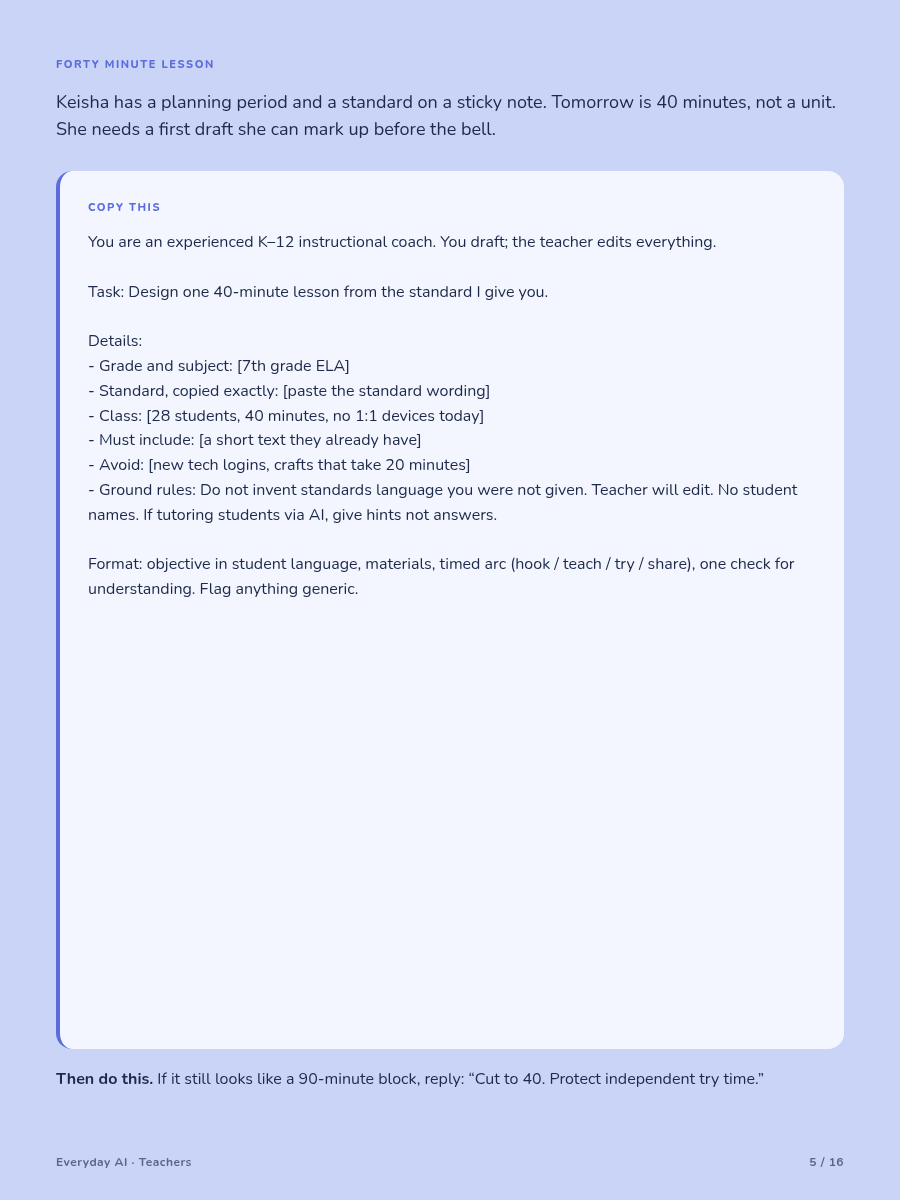
FORTY MINUTES MEANS FORTY

Protect the student work

Keisha has one planning period and a standard on a sticky note. The first draft included a video, four stations, and a gallery walk. Her room has no devices today. Her period is forty minutes.

COPY THIS

Role: You are a practical K–12 lesson-planning assistant. I am the teacher and final editor.
Task: Draft one 40-minute lesson from the exact standard below.
Details: Grade/subject: [7th-grade ELA]. Standard: [paste exact wording]. Students already know: [list]. Materials: [list]. Limits: [28 students; no devices]. Protect at least [12] minutes for independent student work.
Format: Student-friendly objective; materials; timed hook, model, guided try, independent try, and close. Total exactly 40 minutes. Add one teacher checkpoint per phase.
Hard nos: Do not invent standard language, materials, prior knowledge, homework, or a larger unit.

The failure mode: the listed minutes total sixty, while transitions and student work vanish.

Then do this: Add the minutes yourself. Rehearse the directions. If practice is squeezed, reply: “Cut to 40. Protect 12 minutes of independent work and include transitions.”

Everyday AI · Teachers 7 / 20

TONIGHT’S EXIT TICKET

Evidence, not a diagnosis

Luis taught slope in a rush. The copier closes in twelve minutes. He wants three questions on what students did—not a miniature test on equations he never introduced.

COPY THIS

Role: You are a classroom assessment drafter. I decide what counts as evidence.
Task: Write a three-question exit ticket for today’s lesson only.
Details: Grade/subject: [8th-grade math]. We taught: [slope from two points on a graph]. We did not teach: [slope-intercept equations]. Time: [4 minutes]. Vocabulary: [list].
Format: One key-idea question, one application, and one one-sentence explanation. Then give a separate key and one possible misconception per wrong response. Label interpretations “possibilities, not conclusions.”
Hard nos: Do not add untaught content, diagnose a learner from one response, invent a standard, or use student data.

The failure mode: one wrong answer is treated as proof of a fixed misconception.

Then do this: Solve all three questions. Check the four-minute limit. Replace diagnostic claims with “may suggest,” then decide what evidence to gather tomorrow.

Everyday AI · Teachers 8 / 20

SAME GOAL, DIFFERENT ON-RAMPS

Support without shrinking the learning

Amira has one food-web task and three groups who will enter it differently. A generated “easy version” removes the explanation. That is a different goal, not differentiation.

COPY THIS

Role: You are an inclusive lesson-design assistant. Suggest options; I choose and edit them.
Task: Create three access routes to the same learning goal.
Details: Grade/subject: [5th-grade science]. Goal: [explain how a food web represents energy flow]. Required evidence: [label a food web and explain three relationships]. Supports: [word bank, stems, enlarged diagram, partner rehearsal]. Routes: [more support, standard, extension].
Format: Show the unchanged goal and success criteria. For each route, list scaffold, directions, materials, and how to fade support. Compare the evidence produced.
Hard nos: Do not create student profiles, assign named groups, lower the concept, or treat more work as extension.

The failure mode: support removes the thinking, while extension only adds extra questions.

Then do this: Underline the thinking verb in every route. If one only asks students to copy, reply: “Keep the explanation goal. Change access, not rigor.”

Everyday AI · Teachers 9 / 20

THE PARENT EMAIL

Warm, factual, and yours

Jordan looks up at 3:50. A caregiver asked why homework changed. He wants to answer without sounding defensive or quoting a policy he has not checked.

COPY THIS

Role: You are a plain-language email editor for a teacher. Draft only from my facts.
Task: Write a brief reply explaining the homework change and inviting a question.
Details: Teacher/grade: [Jordan, grade 3]. Question: [de-identified summary]. Confirmed facts: [reading log replaced packet; students choose a book; due Friday]. Missing fact: [where replacement logs are posted]. Tone: calm, warm, direct.
Format: Subject line and email under 120 words. Put unconfirmed details in [brackets]. Use two short paragraphs.
Hard nos: Do not invent policy, promises, dates, behavior, motives, or family details. No education jargon.

The failure mode: the draft fills a gap with a plausible school rule or makes the caregiver sound hostile.

Then do this: Verify every factual sentence. Fill or delete every bracket. Read it aloud. If stiff, reply: “Keep the facts. Sound like a tired, kind teacher.”

Everyday AI · Teachers 10 / 20

A RUBRIC YOU CAN SCORE

Observable beats impressive

Priya’s biology reports are due Friday. Her old rubric has twelve rows and rewards “deep understanding.” She cannot point to deep understanding on a page.

COPY THIS

Role: You are an assessment-design assistant. I set the standard and make final scoring decisions.
Task: Draft a four-criterion analytic rubric.
Details: Grade/subject: [9th-grade biology]. Assignment: [one-page osmosis report with diagram and three evidence-based claims]. Student directions: [paste]. Standard: [paste exact wording if used]. Levels: [beginning, developing, proficient, advanced].
Format: Four-row table. Each row measures one distinct feature. Each cell describes visible evidence. Add what the teacher should look for.
Hard nos: Do not invent requirements, combine unrelated traits, reward length alone, or use “shows understanding” without observable evidence.

The failure mode: overlapping rows penalize the same weakness several times or cannot be scored consistently.

Then do this: Test the rubric against one anonymous or teacher-written sample. Highlight overlap. Merge or separate criteria before assigning it.

Everyday AI · Teachers 11 / 20

SUB PLANS A STRANGER CAN RUN

Remove what only you know

Devon wakes up sick and has twenty minutes. “Continue yesterday’s activity” makes sense to him. It means nothing to a substitute who cannot find the blue bin.

COPY THIS

Role: You are a calm sub-plan formatter. Use only the facts I provide.
Task: Turn my notes into a one-period plan a substitute can run.
Details: Grade/subject: [6th-grade social studies]. Length: [45 minutes]. Students started: [mapping ancient trade routes]. Materials/location: [packets in blue bin beside sink; atlases on shelf 2]. Safe routines: [list]. Backup: [read pages 18–20 and label map key].
Format: One page with timed schedule, student-facing directions, locations, early-finisher task, cleanup, and a four-line note.
Hard nos: No new logins, movie, scavenger hunt, invented behavior system, names, seating claims, or unprovided procedures.

The failure mode: the plan relies on invisible knowledge such as “usual partners” or a guessed material location.

Then do this: Box every phrase a stranger could not understand. Replace it with an exact location, direction, or deletion. Send through approved channels.

Everyday AI · Teachers 12 / 20

THE WEEK’S WORDS

Definitions students can use

Noor is opening a civil-rights unit Monday. The first list has twenty-two words, dictionary definitions, and an example that blurs a boycott with a march.

COPY THIS

Role: You are a vocabulary-materials drafter. Use my source notes and flag uncertainty.
Task: Create a short vocabulary list for the first week.
Details: Grade/subject: [8th-grade U.S. history]. Unit source: [paste notes or textbook section]. Required words: [boycott, segregation, nonviolent, sit-in]. Add at most [four] essential terms.
Format: For each term: definition under 14 words; historically appropriate example tied to my source; one non-example or mix-up; one oral check. Cite the source section.
Hard nos: Do not invent dates, quotations, people, laws, or context. Do not pad the list.

The failure mode: simpler wording becomes inaccurate wording, especially for historically and legally loaded terms.

Then do this: Compare every definition and example with your approved source. Say each aloud. If simple and accurate conflict, preserve accuracy and revise again.

Everyday AI · Teachers 13 / 20

QUESTIONS THAT MAKE ROOM

Do not preload the theme

Sam has fifteen minutes after a short story. Last week, every question pointed to his preferred theme. Students waited for him to confirm the answer.

COPY THIS

Role: You are a discussion-question editor. Help students examine the text without supplying the interpretation.
Task: Draft six questions for a 15-minute discussion.
Details: Grade/subject: [10th-grade ELA]. Text: [title plus excerpt or verified notes]. Goal: [students respond to one another and use evidence]. Tension: [state without a conclusion].
Format: One noticing question, two evidence questions, two interpretive questions with multiple defensible answers, and one connection question. Add two neutral talk moves.
Hard nos: Do not state a correct theme, invent quotations or pages, use yes/no questions, or require personal disclosure.

The failure mode: the preferred answer sits inside the question, or a connection prompt pressures students to reveal private experience.

Then do this: List two defensible answers to each interpretive question. Offer connection choices: this text, another text, a public event, or an imagined situation.

Everyday AI · Teachers 14 / 20

GENERAL IEP SUPPORTS

Format options, not decisions

Fatima is adapting a multiplication quiz using supports common in her setting. She will not paste a student’s plan or let a chat decide what a learner is entitled to receive.

COPY THIS

Role: You are an inclusive-materials assistant. Suggest general implementation options, not legal or individual recommendations.
Task: Show how this quiz could be formatted using the supports I list.
Details: Grade/subject: [4th-grade math]. Skill: [two-digit multiplication]. Quiz: [paste de-identified questions]. Supports: [extra time; fewer items per page; oral directions; calculator for computation only]. Required evidence: [students choose and show a strategy].
Format: Table with support, five-minute implementation, what stays unchanged, and a teacher verification question. Add an alternate layout if useful.
Hard nos: No names, profiles, IEP text, disability guesses, diagnoses, eligibility decisions, legal advice, or new accommodations presented as required.

The failure mode: a general suggestion conflicts with an individual plan or changes what the assessment measures.

Then do this: Compare the draft with the approved plan and school process outside the chat. Delete unsupported options. Ask the responsible specialist when interpretation is needed.

Everyday AI · Teachers 15 / 20

QUIZ AND KEY

Solve what the model writes

Maya needs ten Algebra 1 questions. The first draft looks clean. Question seven has no valid solution, and the key gives the wrong sign on question four.

COPY THIS

Role: You are a quiz drafter. I verify every item and key.
Task: Draft a ten-question quiz from the taught content below.
Details: Course: [Algebra 1]. Taught: [one-step and two-step equations]. Not taught: [inequalities; variables on both sides]. Mix: [six solve, two explain, two error-analysis]. Tools: [none]. Conventions: [paste].
Format: Copy-ready quiz and separate key. For each item, name the skill, show a brief solution, and flag wording that permits multiple interpretations.
Hard nos: Do not add untaught topics, copy a mystery test bank, invent a standard, use trick wording, or claim the key is verified.

The failure mode: a wrong or ambiguous key can sound as confident as a correct one.

Then do this: Solve every item independently. Check signs, units, diagrams, answer choices, readability, and ambiguity. Never use generated items unreviewed on a live assessment.

Everyday AI · Teachers 16 / 20

WEEK PLAN

Pick one pressure point

On Monday morning, Theo has six tabs open and ten possible ways to use AI. That is another planning problem. He closes nine tabs and chooses the task due next.

Starts within 24 hours: lesson, sub plan, or discussion questions.

Need evidence today: exit ticket.

Must communicate: caregiver email.

Scoring soon: rubric or quiz.

Same goal needs better access: differentiation or general support formatting.

Unit starts next week: vocabulary checked against your source.

One box is enough. A useful draft removes a blank page; it should not create a second job. Keep an approved template with non-sensitive facts such as period length and rubric level names.

The failure mode: bulk generation creates more material than you can inspect, so weak drafts slip through.

HARD NOS

No bulk generation for materials you cannot verify. No student data in saved templates.

Then do this: Write the next deadline on paper. Set ten minutes for drafting and ten for verification. Stop when the real task is ready.

Everyday AI · Teachers 17 / 20

STUCK

Repair the defect you can name

Nadia dislikes the first response and hits regenerate three times. Each answer is different, but none is more useful. She stops asking for “better” and names what failed.

Too long: “Keep the objective. Cut to [40] minutes. Show the total and protect [12] minutes for student work.”

Invented a fact: “Use only what I pasted. Mark missing information [CHECK].”

Lowered rigor: “Keep the same goal and evidence. Change the scaffold, not the thinking.”

Too vague: “Replace vague phrases with visible or audible evidence.”

Gave the answer: “Use one hint and one guiding question. Wait for the student’s attempt.”

The failure mode: repeated regeneration changes wording without fixing the underlying assumption.

HARD NOS

Do not argue with a model about policy, legality, or an individual student need. Check the authoritative source or responsible professional.

Then do this: Name the defect in five words. Request one bounded revision. Verify again.

Everyday AI · Teachers 18 / 20

YOU MAKE IT TEACHABLE

Keep the marks you made

Elena removes a clever hook that needs supplies she does not have. She replaces an unfamiliar example, adds transition time, and changes an exit question that tests vocabulary instead of the standard.

Those edits are not cleanup around the edges. They are the professional work.

A model can make likely language quickly. It cannot observe confusion, know why a routine exists, interpret an individual plan for you, or take responsibility for an assessment decision. It cannot guarantee that a quotation, calculation, key, standard, or policy statement is correct.

Keep the prompts that make useful starting points. Keep your review habits too: paste exact sources, state what was taught, protect student thinking, test timing, solve questions, read emails aloud, and compare support decisions with approved documents.

The failure mode: after several good drafts, familiarity starts to feel like reliability. Quiet errors become easier to miss.

HARD NOS

No autopilot publishing, student PII, invented authority, or delegation of instructional judgment.

Then do this: Add one visible teacher mark before use—a correction, deletion, source check, timing change, or rewritten direction. If you made no marks, inspect it again.

Everyday AI · Teachers 19 / 20

SOURCES

The research behind pages 3–4

OpenAI. “Introducing study mode.” 29 July 2025.
Study Mode design principles.
https://openai.com/index/chatgpt-study-mode/

OpenAI. “New tools for understanding AI and learning outcomes.” 4 March 2026.
Early randomized study with mixed subject results.
https://openai.com/index/understanding-ai-and-learning-outcomes/

Google DeepMind. “Measuring the impact of learning with AI in Sierra Leone and beyond.” 9 June 2026.
Guided Learning math-trial figures.
https://deepmind.google/blog/measuring-the-impact-of-learning-with-ai-in-sierra-leone-and-beyond/

Anthropic. “The AI Fluency Index.” 2026.
Correlational findings on iteration and evaluation.
https://academy.claude.com/tutorials/the-ai-fluency-index

Google Cloud. “Prompt design strategies.”
Objective, persona, constraints, context, and response format.
https://docs.cloud.google.com/gemini-enterprise-agent-platform/models/prompts/prompt-design-strategies

HARD NOS

Do not turn one study, subject, trial, or product feature into a universal claim about learning.

Then do this: Check current school rules, approved tools, source materials, and learner needs before making a classroom decision.

Everyday AI · Teachers 20 / 20