Work

Cover of Land the Job with AI

Land the Job with AI

A resume, a letter, and interview answers that sound like you.

Anyone can use this page. Copy the prompt and try it today.

$6.99

Buy · $6.99

A page inside

A page inside Land the Job with AI: Thirty second skim

Everyday AI

Land the Job with AI

Stories, follow-ups, and interview prep from your notes.

You stay the editor. The model drafts. You decide.

$4.99 · 20 pages

Beginner shelf · STAR stories · you stay the candidate

Everyday AI · Job Hunt1 / 20

CONTENTS

What's in this book

Read pages 3 through 6. Then copy one cream box.

03The Idea — You stay the candidate
04What The Labs Found — Edit first. Check twice.
05Before You Paste — Build the truth pile
06How To Use This — One real task. One checked draft.
07Thirty-Second Skim — Find the mismatch before rewriting
08Three Real Bullets — Turn notes into evidence
09Cover Letter Skeleton — Start without performing enthusiasm
10Linkedin About — Sound like a person, not a brochure
11One Star Story — Keep the decision and the result
12Mock The Screen — Practise follow-up, not memorization
13The Thank-You — One detail. No invented chemistry.
14Pay Questions — Research before choosing a number
15The Gap In One Breath — Neutral. True. Finished.
16Ask For Advice — Make the relationship recognizable
17One-Hour Sprint — Finish one checked send
18Stuck — Repair the draft, not your career
19Final Evidence Audit — You did the work
20Sources — The research behind the method
Everyday AI · Job Hunt2 / 20
THE IDEA

You stay the candidate

A chat can arrange words. It did not do your job. It was not beside you when the shipment failed, the client changed scope, or the new hire needed help.

It was not in the room. If it adds a metric, title, tool, employer, client, date, credential, or responsibility, delete it.

A prompt is a job. Give it a Role, Task, Details, and Format. Add the limits that matter.

Use it as an editor. OpenAI found that about two-thirds of work-related writing messages ask ChatGPT to modify text the user supplied.

You stay the candidate. Tailoring makes relevant facts easier to see. It does not turn you into the person described in the posting.

Hard nos: No invented career facts. No team output claimed as solo work.

Then do this. Apply the ten-minute test: if you cannot explain a line under friendly follow-up, it does not leave your screen.

Everyday AI · Job Hunt 3 / 20
WHAT THE LABS FOUND

Edit first. Check twice.

1 — OpenAI. Writing made up about 40 percent of work-related ChatGPT messages. Most consumer use was still non-work.

2 — OpenAI. About two-thirds of writing messages asked the model to change text the user supplied. Bring your resume and notes.

3 — Anthropic. Its AI Fluency Index found that people who iterated also showed more clarifying and evaluation behaviors. This is correlation, not proof of causation.

4 — Google. Useful prompts name an objective, persona, context, constraints, and response format.

None of these sources measured job offers or interview win rates. They support an editing method, not a hiring promise.

Hard nos: Do not turn writing research into a claim that AI lands jobs.

Then do this. Carry one rule forward: edit first, invent never, check the polished line twice.

Everyday AI · Job Hunt 4 / 20
BEFORE YOU PASTE

Build the truth pile

Nora's old resume says she “improved onboarding,” but she cannot remember whether the change covered twelve hires or fourteen. A loose memory can become a confident number after one paste.

Certain: facts you can defend.

Check: numbers, dates, tools, names, and scope needing a record.

Context: what happened and why your action mattered.

Not mine: team results you should not claim alone.

BEFORE-YOU-PASTE SCRIPT

I am editing a truthful application. Missing details must stay missing. Anything uncertain goes in brackets. Team work stays team work. The posting tells me what matters; it does not prove I have done it.

Hard nos: No Social Security numbers, home addresses, confidential client data, restricted documents, or references' private contact details.

Then do this. Replace names with labels such as [client]. Verify fuzzy numbers before using them.

Everyday AI · Job Hunt 5 / 20
HOW TO USE THIS

One real task. One checked draft.

Use the page that matches the next thing you must send or practise. One task tonight is enough.

  1. Replace every bracket with real material.
  2. Paste long source material before the instruction.
  3. Compare the reply with your sources line by line.
  4. Edit in your words. Send only after the truth check.

Keep one thread per role, not one thread for every application. That reduces employer mix-ups.

Hard nos: No invented employers, metrics, titles, tools, dates, credentials, salary figures, quotes, references, or social proof. Do not add a requirement merely because it appears in the posting.

This is practical writing support, not career, legal, immigration, or compensation advice. The model drafts. You decide.

Then do this. Add four to six sentences from a real email as a voice sample. Remove private details first.

Everyday AI · Job Hunt 6 / 20
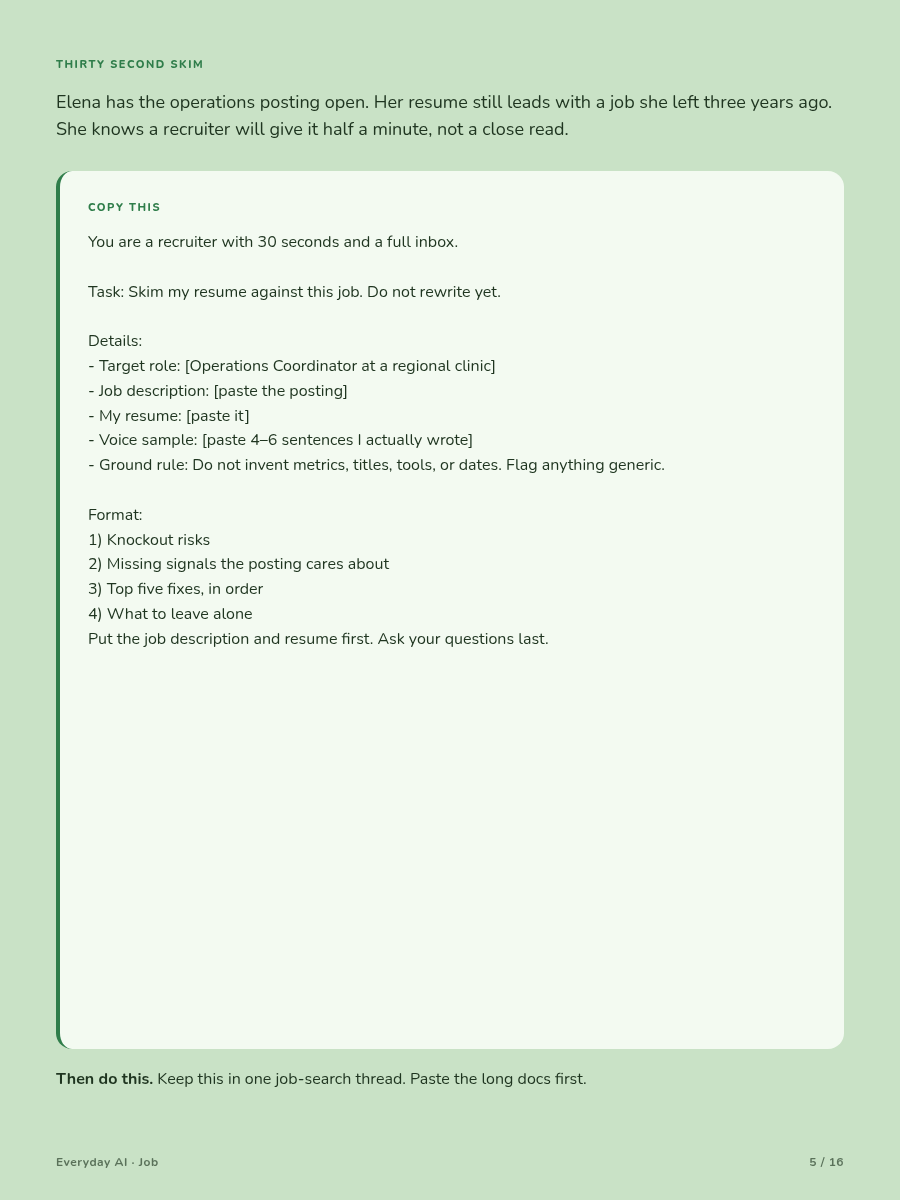
THIRTY-SECOND SKIM

Find the mismatch before rewriting

Elena's clinic-operations resume leads with an old retail role. Her relevant scheduling work is buried on page two. She needs a diagnosis, not a total rewrite.

COPY THIS

Role: You are a recruiter doing a fast first review.

Task: Compare my resume with this posting. Diagnose only. Do not rewrite.

Details: Posting: [paste]. Resume: [paste]. Target role: [title].

Format: Requirements evidenced; requirements not evidenced; possible knockout risks; top five edits; lines to leave alone. Quote source lines.

Hard nos: Do not infer I possess a missing skill. Do not invent experience, credentials, metrics, titles, tools, employers, or dates. Keep preferred and required qualifications separate.

Then do this. Check every “missing” signal. It may be absent from the resume but present in your real history. Add it only if true.

Everyday AI · Job Hunt 7 / 20
THREE REAL BULLETS

Turn notes into evidence

Marcus wrote, “Saturday schedule mess; covered two closings; shrink review went well.” The model would love to supply a percentage. Marcus does not have one.

COPY THIS

Role: You are a plain-spoken resume editor who rejects unsupported impact.

Task: Rewrite exactly three bullets. Show the problem, my action or decision, and the supported result.

Details: Target role: [title]. Existing bullets: [paste]. Raw notes: [paste]. Confirmed facts: [paste]. Voice sample: [paste].

Format: Draft bullet; facts used; fact still missing. Keep each under [length].

Hard nos: No invented numbers, dates, tools, titles, scope, savings, revenue, rankings, promotions, or praise. Do not change “helped” into “led.”

Then do this. Underline every noun and number. Point to its source. If you cannot, remove or bracket it.

Everyday AI · Job Hunt 8 / 20
COVER LETTER SKELETON

Start without performing enthusiasm

Priya is still at the library because the empty letter feels worse than a bad draft. She needs a frame, not a love letter to a company she barely knows.

COPY THIS

Role: You are a concise application editor, not a marketer.

Task: Build a cover-letter skeleton from my true notes.

Details: Posting excerpt: [paste]. Two relevant examples: [paste]. One verified reason this role interests me: [paste]. Voice sample: [paste].

Format: Three short paragraphs and a one-line close, under 250 words. Bracket missing facts.

Hard nos: Do not invent company values, admiration, relationships, metrics, tools, titles, or culture knowledge. No “dream company” or “perfect fit.”

Then do this. Delete the company name and reread. If the letter fits twenty employers, add one verified posting detail.

Everyday AI · Job Hunt 9 / 20
LINKEDIN ABOUT

Sound like a person, not a brochure

Devon's About calls him “results-driven” and “passionate about synergy.” His real strength is keeping clinic openings from surprising clinicians and vendors.

COPY THIS

Role: You are a skeptical LinkedIn reader who skips buzzwords.

Task: Draft an About section using my real scope and voice.

Details: Current role: [paste]. Verified scope: [paste]. Work I do: [paste]. Two proof points: [paste]. Voice sample: [paste].

Format: Six to eight short first-person lines, then three short headlines. Mark weak claims [PROVE].

Hard nos: No invented metrics, years, tools, industries, leadership scope, clients, awards, or availability. Avoid “guru,” “visionary,” “synergy,” and “results-driven.”

Then do this. Cut 20 percent. Ask someone who knows your work whether the first two lines sound like you.

Everyday AI · Job Hunt 10 / 20
ONE STAR STORY

Keep the decision and the result

Jordan's go-live story takes four minutes. He explains every meeting but never says what he decided or what happened Monday.

COPY THIS

Role: You are an interview coach who protects factual boundaries.

Task: Shape this story into STAR. Ask questions before drafting if ownership or result is unclear.

Details: Target role: [paste]. Raw story: [paste]. My exact responsibility: [paste]. Confirmed result: [paste or unknown].

Format: Ask up to five questions and wait. Then give 60- and 90-second outlines, the decision sentence, result sentence, and one follow-up.

Hard nos: Do not invent metrics, dates, tools, conflict, praise, or results. Do not turn team action into solo action.

Then do this. Speak from the outline without reading a script. If you ramble, ask: “Cut background. Keep my decision and verified result.”

Everyday AI · Job Hunt 11 / 20
MOCK THE SCREEN

Practise follow-up, not memorization

Fatima has twenty minutes on the couch. Her answers start well, then become a tour of every job she has held.

COPY THIS

Role: You are a recruiter conducting a first phone screen for this posting.

Task: Interview me one question at a time. Interrupt politely when I ramble. Probe unsupported claims.

Details: Posting: [paste]. Resume: [paste]. Screen length: [20 minutes]. Evaluate clarity, relevance, concision, and evidence.

Format: Ask one question and wait. After each answer give: Clear; Missing; Cut. Debrief only when I ask.

Hard nos: Do not invent company policy, hiring criteria, questions, metrics, or facts about me. Do not provide polished answers before I try.

Then do this. Repeat the weakest answer with three anchors: point, example, result. Keep the anchors, not the script.

Everyday AI · Job Hunt 12 / 20
THE THANK-YOU

One detail. No invented chemistry.

Sam's call ended at 4:40. He remembers weekend coverage and a vendor no-show. He does not need to claim that they “connected deeply.”

COPY THIS

Role: You are a concise follow-up editor.

Task: Draft a thank-you email I can review and send today.

Details: Recipient: [paste]. Role: [paste]. Two exact conversation details: [paste]. One clarification: [paste or none]. Voice sample: [paste].

Format: Two subjects and one email under 120 words. Include thanks, one specific, and a calm close.

Hard nos: Do not invent rapport, jokes, next steps, commitments, quotes, shared interests, or interviewer enthusiasm. Do not beg.

Then do this. Check names, role, and details against your notes. If it sounds needy, ask for shorter, with one specific and no predictions.

Everyday AI · Job Hunt 13 / 20
PAY QUESTIONS

Research before choosing a number

Riley's posting says “competitive compensation.” A friend mentioned another company's range, but Riley cannot verify that it fits this role.

COPY THIS

Role: You are a compensation-research organizer, not an adviser.

Task: Build questions and a source-checking plan. Do not select my target number.

Details: Role, level, location, arrangement: [paste]. Public ranges with URLs and dates: [paste or none].

Format: Eight questions; a source/date/location/level/range/caveat table; three neutral scripts for asking about the approved band.

Hard nos: Do not invent salary figures, averages, benefits, bonuses, equity, taxes, leverage, or company policy. Label absent evidence “source needed.”

Then do this. Bring figures only from dated listings, official disclosures, or real conversations. Check level, location, and definitions.

Everyday AI · Job Hunt 14 / 20
THE GAP IN ONE BREATH

Neutral. True. Finished.

Alex took eleven months away to care for a parent. Alex will not turn the gap into fictional full-time consulting or share a parent's diagnosis.

COPY THIS

Role: You are a humane application editor who treats career gaps plainly.

Task: Help me explain this gap without fiction or oversharing.

Details: Verified dates: [paste]. Reason I choose to disclose: [paste]. Work or learning that truly continued: [paste or none]. Current readiness: [paste].

Format: A 20-second spoken version; a two-line resume option; one calm follow-up; details I can keep private.

Hard nos: Do not invent consulting, clients, courses, credentials, dates, medical facts, or productivity. Do not diagnose anyone or promise an employer's response.

Then do this. Remove details belonging to another person. If the answer sounds ashamed or glossy, ask for neutral facts and one readiness line.

Everyday AI · Job Hunt 15 / 20
ASK FOR ADVICE

Make the relationship recognizable

Maya's draft praises a former teammate's “incredible journey.” They never discussed a journey. They did ship a difficult Friday dashboard together.

COPY THIS

Role: You are a relationship-first networking editor.

Task: Draft a brief advice request, not a referral request.

Details: Person and relationship: [paste]. One real shared memory: [paste]. What I hope to learn: [paste]. Time requested: [15–20 minutes]. Voice sample: [paste].

Format: Subject; note under 90 words; six specific conversation questions. Make declining easy.

Hard nos: Do not invent memories, praise, closeness, openings, referrals, employer knowledge, or mutual contacts. Do not ask for a job. No “pick your brain.”

Then do this. Check whether the first two lines identify the real shared work. Replace flattery with one true detail.

Everyday AI · Job Hunt 16 / 20
ONE-HOUR SPRINT

Finish one checked send

Luis has seven job tabs open at 8:10 p.m. He is switching between them and finishing none. Tonight's goal is one defensible application.

COPY THIS

Role: You are a quiet work-session planner.

Task: Turn one application into a 60-minute sequence using only my tasks.

Details: Deadline: [paste]. Materials ready: [paste]. Tasks remaining: [paste]. Energy: [low/medium/high].

Format: Four blocks totaling 60 minutes: evidence check, targeted edits, optional letter, final audit and submit. Add one stop rule and parking list.

Hard nos: Do not add achievements, extra applications, networking chores, or unrequested research. Do not tell me to submit before checking names, dates, links, and claims.

Then do this. Close the other tabs. At the final audit, compare every changed claim with your truth pile.

Everyday AI · Job Hunt 17 / 20
STUCK

Repair the draft, not your career

The first reply may be polished and wrong. Use the smallest repair that matches the problem.

Invented fact: “List claims not copied from my source. Remove them or mark [NEEDS FACT].”

Inflated scope: “Do not change helped, supported, coordinated, or contributed into led, owned, or directed.”

Generic voice: Paste a real email. Ask it to match sentence length and directness, facts unchanged.

Employer mix-up: Start a clean thread. Check every proper noun.

Salary guess: Delete the number. Ask for questions and source fields only.

Hard nos: Never accept a correction without checking the revised line too. Unknown is an acceptable output.

Then do this. Reset when good earlier lines make you stop checking later ones. Correction fatigue is a real failure mode.

Everyday AI · Job Hunt 18 / 20
FINAL EVIDENCE AUDIT

You did the work

Tessa is ready to submit at 11:06 p.m. One bullet now says she “owned” a rollout she actually coordinated. This is the moment that matters.

Can I explain every bullet under follow-up?

Are employers, titles, dates, credentials, tools, and links accurate?

Did team output become a solo claim?

Did a missing number become an estimate?

Did the posting lend me a skill I have not used?

Are the company name, recipient, role, and attachments correct?

Did I remove private and confidential material?

Hard nos: No sending because the prose looks finished. No unsupported claim survives the audit.

Then do this. Restore “coordinated.” Save the true version. Submit only when every line is yours to defend.

The model lined up words. You supplied the career and own the final check.

Everyday AI · Job Hunt 19 / 20
SOURCES

The research behind the method

The practical job-search guidance is editorial guidance. These sources support only the lab claims and prompt structure. They do not show that AI increases job offers, interviews, or pay.

OpenAI. “How people are using ChatGPT.” 15 Sep 2025. Writing share, modification share, and work/non-work use.
https://openai.com/index/how-people-are-using-chatgpt/

Anthropic. “The AI Fluency Index.” 2026. Correlational associations between iteration and other fluency behaviors.
https://academy.claude.com/tutorials/the-ai-fluency-index

Google Cloud. “Prompt design strategies.” Current documentation. Objective, persona, context, constraints, and response format.
https://docs.cloud.google.com/gemini-enterprise-agent-platform/models/prompts/prompt-design-strategies

Hard nos: Do not claim these sources measured hiring success.

Then do this. Use sources for what they measured. Use your records for what you did.

Everyday AI · Job Hunt 20 / 20